U.S. WealthTech companies raised $949 million across 82 deals in Q1 2026, a 95% increase year over year, according to FinTech Global. Farther closed a $150 million Series D. Arca raised $48.5 million to expand its AI-powered advisor platform.
Obviously the money isn't the hard part right now. The hard part is whether these systems actually serve the advisors who have to work inside them, and that is a harder thing to buy than a funding round.
I want to be careful with the claim here, because it is easy to overstate. I am not saying design is the single thing standing between these companies and success. Plenty of factors decide that. What I am saying is narrower and, I think, more defensible: capital is necessary but not sufficient, and from what I am seeing, the thing that separates the WealthTech platforms that compound from the ones that stall is whether the product was built around how advisors actually think and work.
That distinction carries more weight in financial services than almost anywhere else. An advisor working inside a poorly designed platform does not just get frustrated. They miss things. And clients feel that as the difference between a relationship that feels handled and one that feels exposed. In this context, good design is not a preference. It is closer to a professional obligation.
What The Investment Surge Actually Signals
A 95% year-over-year jump in WealthTech investment does not only mean more companies are getting funded. It means the product complexity in this category is scaling faster than the teams solving it.
When capital concentrates in a vertical this quickly, a familiar sequence follows. Companies hire fast and build fast. The product surface expands with new features, new integrations, new user types. Then the experience starts to fragment. What worked for 20 advisors breaks at 200. What felt intuitive in the MVP turns opaque in the scaled product.
The UX debt compounds quietly. By the time it is visible, it is structural.
WealthTech is sitting right at this inflection point. Platforms that raised Series A capital in 2023 and 2024 are now scaling into complexity their original design thinking never anticipated. The 2026 funding surge is adding speed to systems that already needed better architecture.
So the question worth asking, before anyone celebrates the funding line, is a simple one. Was this platform built around a real understanding of how advisors think and work? Or was it built around what was technically interesting and shipped fast to catch the moment? Both can raise $150 million. From what I have seen, only one of them keeps its users.
The Design Challenge Has Moved
For most of the last decade, the hard problem in WealthTech was data. Getting clean data into the system, presenting it accurately, making it usable for advisors who were not technical. That problem is largely solved now. The infrastructure exists.
The harder problem today is different. How do you present that data, in real time, across planning, tax, estate, compliance, and portfolio management, without overwhelming the advisor who has to act on it?
Oliver Wyman's 2026 WealthTech analysis describes what they call the “unified client brain”: a governed, real-time layer that tracks relationships, holdings, behavioral preferences, and risk tolerances, then surfaces next-best-action recommendations at the right moment.
The interesting part is not building that engine. It is the interface between an engine that knows everything and a human advisor with 80 clients, a dozen open planning conversations, and 45 minutes before the next call.
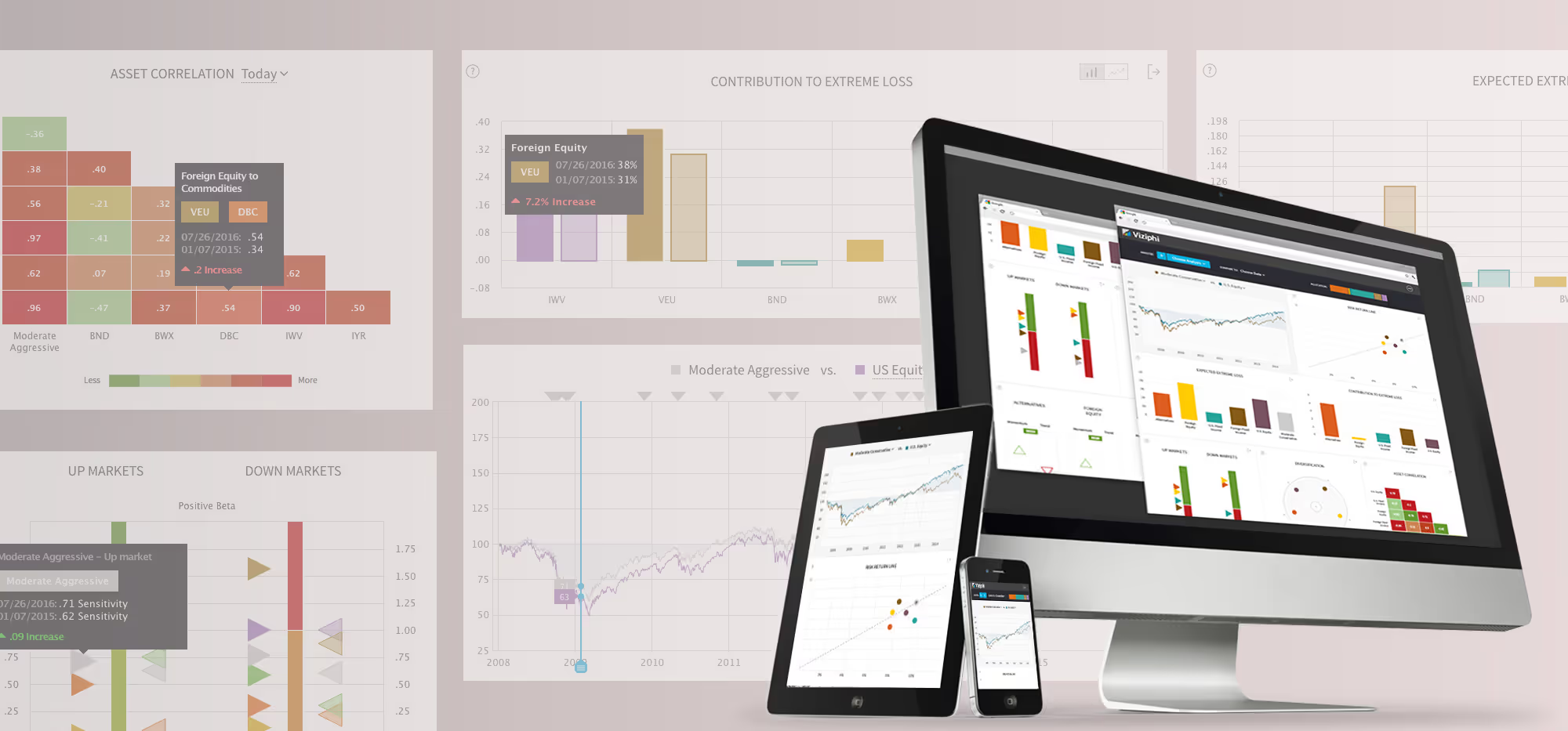
The challenge has moved from access to delivery. The question is no longer whether we have the right information. It is whether we can surface the right signal, to the right person, at the right moment, in a form they can actually use. Dashboard fatigue is the failure mode I see most often in enterprise WealthTech right now, and it gets worse every time a platform adds a capability without the information architecture to hold it.
What Advisor Operating Systems Actually Need
The category already has a name for where it is going. Arca, Farther, and Wealth.com are all building toward the same shape: an advisor operating system that handles planning, tax, estate, portfolio management, communication, and compliance in one place, without forcing the advisor to context-switch across tools.
The Oasis Group's 2026 estate planning technology report noted that Wealth.com, Vanilla, and Luminary have pulled ahead precisely because they integrate cleanly with the broader WealthTech stack rather than sitting off to the side as point solutions.

Building something like that surfaces three design problems worth naming.
Workflow orchestration. When planning, tax, estate, and compliance all live in one experience, the information architecture carries enormous weight. Every choice about what appears when, and what stays out of the way until it is needed, is load-bearing. Get it wrong and advisors either miss something that mattered or quietly stop trusting the system.
Human-in-the-loop AI. Every serious platform in this space is adding AI-generated recommendations: next-best actions, planning alerts, risk flags. The design problem is making those recommendations feel like counsel rather than automation. An advisor who cannot see why the system is suggesting something will not act on it, and they are right not to. Explainability is partly a conversion question, but underneath that it is a question of respect. These are professionals being asked to stake a client relationship on a system's output. They deserve to understand the reasoning first.
Design system coherence at scale. As a platform adds capabilities quickly, the design system has to hold. Visual language, interaction patterns, component behavior all have to stay consistent across an expanding surface. When they do not, the experience fragments, and advisors lose confidence in the whole, not because any single screen is broken but because the product stops feeling like it was thought through.
What To Look For In a Design Leader For This Problem
If you are evaluating design leadership for a WealthTech platform right now, a few things actually matter more than the rest.
Regulated-environment depth. The decisions here carry legal and compliance weight. You want someone who has already worked inside that reality, not someone learning it on your product.
AI governance experience. Building next-best-action interfaces, explainability layers, and human oversight takes systems thinking and interaction design at the same time. The aim is to make AI feel like something an advisor can question and understand, not something that acts on them.
DesignOps maturity. At scale, the design system is the product. Someone who can build and hold that infrastructure while still contributing to strategy is genuinely rare.
The player-coach range. At this stage you need a leader who can set direction and still do the work. Pure strategists are slow and expensive. Pure executors do not scale the function.
References
FinTech Global — US WealthTech investments surged by 95% YoY in Q1, driven by growth in large deals
FinTech Global — Farther closes $150m Series D round led by General Atlantic
Business Wire — Arca Raises $64 Million to Revolutionize and Humanize Wealth Management at Scale
Oliver Wyman — 10 Wealth Management Trends For 2026 ("unified client brain")
The Oasis Group — 2026 Peaks Report on Estate Planning Platforms